
Russellville City Directory Sources
Russellville has no single online catalog of directory books. Nothing maps out every publisher's volumes year by year. That gap matters. Start with the Pope County Library System and ask staff to check the shelves for you. State and national repositories hold companion sets worth requesting too. Be specific when you ask. Inclusive years, missing volumes, telephone directories, and reverse sections all matter. So do newspaper microfilm, yearbooks, obituary indexes, and licensed genealogy databases the library can unlock.
| Collection | Years | Where Held | Access |
|---|---|---|---|
| Russellville printed directories | Exact run not published online | Pope County Library | Reference-desk shelf check |
| Telephone directory material | October 1955 to November 1963 | Library of Congress | Free digitized PDF |
| Federal population census | Through 1950 public | NARA and library databases | Free indexes; partner access varies |
| Sanborn editions | 1886, 1892, 1897, 1904, 1908, 1913, 1919 | Library of Congress | Free public-domain images |
| ATU Agricola | 1913 and other repository years | Arkansas Tech University | Digital sections and downloads |
| Probate and wills | Probate from 1831; wills from 1862 | Pope County Clerk | Counter or research request |
A coverage table should separate real holdings from wishful thinking. A catalog gap does not prove that a directory vanished. It only means the next step is a precise request to staff. No invented publisher or date range is needed. For every Russellville volume used, record the details. Note the title page, issue date, publisher, page number, and any missing leaves. Those details make the street directory evidence hold up later.
Checking Russellville Directory Shelves
Keep the library request narrow and concrete. Ask for Russellville printed and telephone directories with reverse sections. Ask also for exact years and gaps, Courier-Democrat microfilm, local yearbooks, obituary indexes, Sanborn access, and genealogy database availability. That wording pushes staff toward real containers and dates. It also keeps the city directory search aimed at sources the library can actually inspect. Work several access channels at once. Start with the catalog and digital collections. Then contact the reference desk for an item-level inventory. Visit in person when a volume, microfilm reel, or database is limited to the building. When the local shelf falls short, search the Arkansas State Archives catalog. Search it by Russellville, Pope County, a surname, school, church, newspaper, or record type. Courthouse dates and archive catalog dates can differ. So cite the keeper and the coverage of every item. Note: Exact Russellville directory publishers and full year runs need shelf verification. Anyone stating them as fact should check first.
Russellville Telephone Directory Run
The strongest verified substitute online is Library of Congress telephone-directory material. It covers October 1955 through November 1963. Check every cover and title page before naming a publisher or issue. These books typically give the subscriber, the street address, and the telephone exchange or number. Some mark a business listing. Others send you to a cross-reference. Remember that a phone book is not a full resident directory. It rarely supplies spouse names, occupations, or owner and renter symbols. One subscription never captures everyone in a home. Even so, this run bridges the years after the latest open census. It can show when a subscriber arrives, changes address, or disappears. Record continued-name conventions, business labels, cross-references, and the exact issue page. Then pair each hit with a deed, probate file, or newspaper notice. A nearby directory edition helps too before concluding anything.
Reading Russellville Directory Entries
No open scan of a standard Russellville printed entry sits in an authoritative spot online. Once library staff hands you a volume, treat its own key as the rulebook. Photograph or cite the title page and the abbreviation page first. Then read the listing on its own terms. Do not assume that symbols from another city mean the same thing here.
| Name | Copy the surname, given name, and initials exactly as printed. |
|---|---|
| Household clues | Record a spouse, widow or widower notation, children, or other adults only when the edition prints them. |
| Work details | Transcribe occupation, employer, and business address without treating a work site as a home. |
| Home entry | Capture house number, street spelling, residence marker, and any owner or renter symbol. |
| Source key | Preserve the edition date, page, publisher, and abbreviation key used to decode the line. |
Three terms often guide the search:
- Criss-cross directory
- A section arranged by street and house number instead of by surname.
- Householder index
- An address-based list of the person whom an edition identifies as the main listed householder.
- Abbreviation key
- The volume’s own legend for shortened words, occupations, relationships, and residence marks.
A telephone listing needs a shorter inventory: subscriber name or initials, street address, exchange and number, business label, cross-reference, issue date, and page. The subscriber is evidence of a dated connection. It is not a full household roll.
Russellville Yearbook Identity Layer
Arkansas Tech University adds a local name layer that printed directories often miss. Its digitized 1913 Agricola came from the Second District Agricultural School. That school is now ATU. It was published by Ragland & Wren. Faculty, student, club, athletics, and advertising sections can help separate classmates, staff, or civic connections. They do not prove a home address. The Arkansas Tech repository view shows how a Russellville city directory search can widen into an institutional archive:
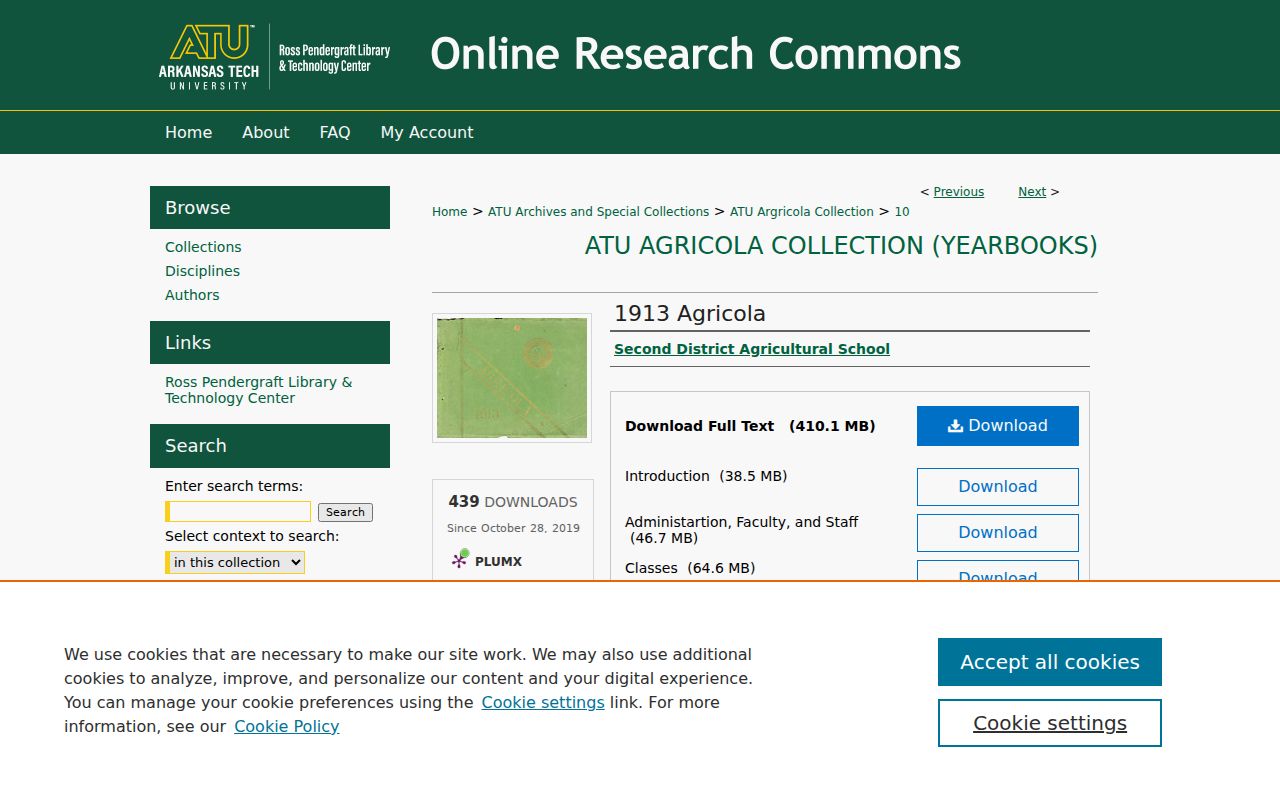
The page matters for a simple reason. It points to a dated local publication rather than a merged name profile. Search initials, nicknames, club roles, and class years. Then test the person against a telephone listing, a census household, an obituary, or a probate record. Current university directories name official roles, but private alumni contact data is not presumed public.
Pair Russellville Directories With Census
Federal population schedules give household snapshots every ten years. The 72-year release rule governs access. The 1950 census is the newest public one in 2026. The 1960 schedules stay closed until 2032. National Archives guidance explains how to reach the released schedules and their indexes. Pairing them with a Russellville street directory turns two weak sources into one strong one. The National Archives screen below is the assigned entry point for Russellville city directory work:
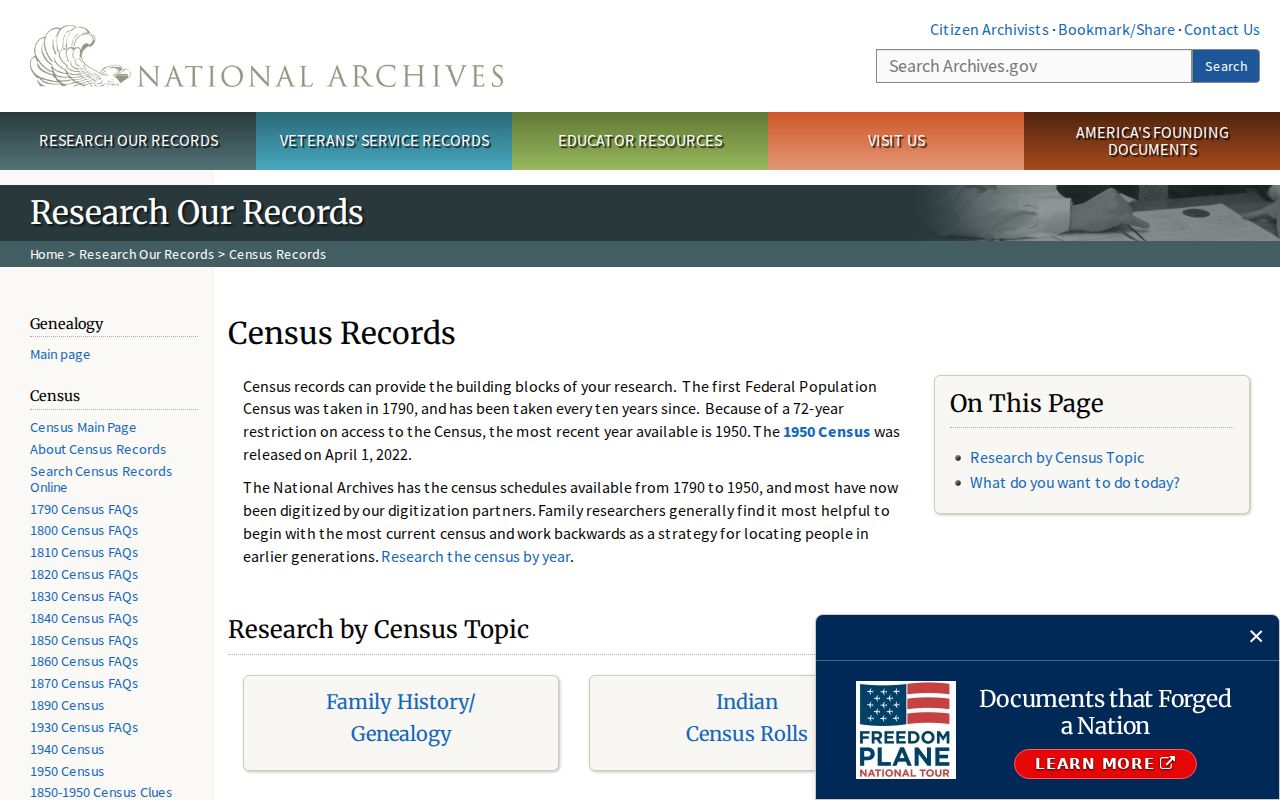
A census may list household members a directory skipped. A nearby directory can narrow a move to a shorter span than the census alone shows. Use both, keep every date visible, and follow the simplest sequence:
- Start with a known census household or a deed owner.
- Check a city directory one year before and after that date.
- Record each spelling, occupation, address, and edition date.
- Follow the name through consecutive editions and test the street or reverse section.
- Use probate, an obituary, or cemetery evidence when the trail ends.
A missing Russellville listing rarely proves a person was gone. A move, a death, a declined entry, a home outside the publisher's boundary, or a name spelled differently can all hide someone from a city directory page.
Map Russellville Directory Addresses
Seven Russellville Sanborn editions survive, dated 1886, 1892, 1897, 1904, 1908, 1913, and 1919. The November 1913 atlas runs to 12 sheets. It records street names, widths, lots, building footprints, materials, uses, water lines, and fire features. Together those details rebuild the built setting around an old address. The digitized 1913 Russellville atlas is free at the Library of Congress.
Sanborn sheets never name residents. They show whether a numbered structure stood at a spot. They also show how the block was laid out. The people layer comes from a city directory or census. Deeds carry title. Later plats and permits explain growth past the older downtown. Russellville spread rapidly after 1950. So modern parcel records matter more once a trail leaves Sanborn coverage behind.
Note: Cite the atlas edition and sheet number. Street labels and building footprints shift between Russellville snapshots.
Russellville Library’s Traveling Collection
Russellville's library history explains why one local item can hide under several institutional names. Books shipped to Camp Pike during World War I came home after the war. They landed in a series of temporary local quarters. A dedicated public-library building opened in 1924. The library joined the Arkansas River Valley Regional Library System in 1957. It moved to a larger building in 1976. It became an independent county system in 1985.
That chronology is practical, not just archival. Old stamps, bookplates, catalog records, and provenance notes may carry a former identity. Some show a regional one. Others show a local one. Search all of them. So a Russellville city directory request should name the city. It should also list Pope County, the regional system, the historic library, and the item type. That habit closes false gaps created by a collection move or a catalog change.
Bridge Russellville Directory Gaps
Courthouse records can carry a family line once printed listings stop. The Pope County Clerk keeps probate from 1887 forward in the office. Probate from 1831 through 1886 sits in a historical vault. Wills date from 1862, and county-court books from 1857. Early estates may name heirs, devisees, guardians, bondsmen, and neighbors. Protected portions stay closed.
Newspapers, obituaries, school yearbooks, church histories, and cemetery records widen the picture. Pope County Historical Association publications can help, though user-contributed family sketches need corroboration. A researcher tracing a former classmate should start with a yearbook and newspaper. An heir search begins with probate. A question about who lives at a home now calls for the modern Russellville street directory workflow. Historical shelves offer little for that.
Trace Russellville Families by Edition
A sound Russellville directory timeline keeps its sources separate. Record what each edition actually says, initials and old street spellings included. Search punctuation variants and marital-name forms too. Rural-route conversions, reused family names, trusts, and business ownership can all create misleading matches. Join one name to one family only after two records agree.
Work outward from the firmest dated fact. A census household, deed, probate caption, or exact telephone listing makes a strong anchor. Compare the editions on either side. Then use the reverse section to test the address and its neighbors where that feature exists. For a modern one-person confirmation, turn to the Russellville resident lookup sources. Do not treat an old listing as current.
Evidence rule. A Russellville directory entry is a dated clue, not proof that every named or unnamed person occupied the address for the full year.